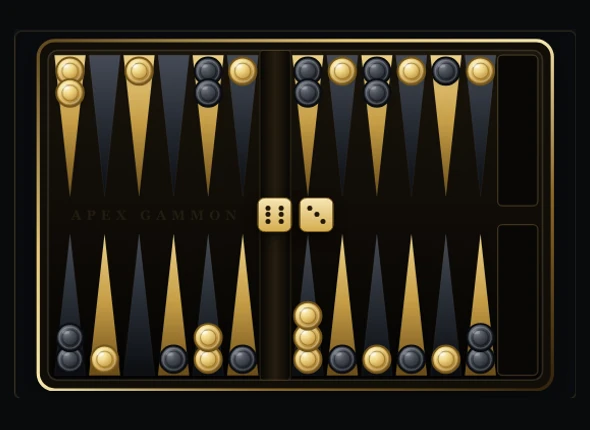
Fair backgammon dice.
Automatic rolls are generated independently of the board, player, result, subscription, and Alpha. Luck analysis is optional and remains separate from decision quality.
The position does not influence the roll.
For production automatic-dice games, each die is mapped from a browser cryptographic random value to one of six faces using rejection sampling when Web Crypto is available. If that API is unavailable, the browser pseudorandom generator is the fallback. Neither the move engine nor the current board is an input to the roll.
Generate 600 die faces.
A short run will not be perfectly even. The bars make ordinary random variation visible instead of treating every uneven sample as evidence of bias.
Generate a sample to compare face counts.
Eligible Standard games remain reproducible.
Automatic Standard games
The saved game record includes the sequence of board positions, moves, and dice needed for private review. This lets Alpha Review return to the same decision rather than reconstructing a different game.
Manual dice
Manual dice exist for study in Tutor mode. Because a person chooses those rolls, manual-dice games are excluded from competitive statistics, luck calculation, Alpha-loss capture, and the saved Standard record.
Luck analysis
Luck is not calculated during play and does not weaken Alpha's move selection. After an eligible Standard game, the player may request a separate dice-sequence analysis. The review remains usable while that calculation runs.
Fair does not mean alternating, balanced, or emotionally convenient.
A random sequence can contain repeated doubles, long gaps without a six, and uneven short samples. A fair generator gives every face the same probability on each independent die; it does not compensate a player for recent rolls or steer the game toward a close result.