Backgammon rules.
Move all fifteen checkers around the board and bear them off before your opponent. The tactical tension comes from open points, hits, the bar, blocked entries, and the fact that both dice must be used whenever legally possible.
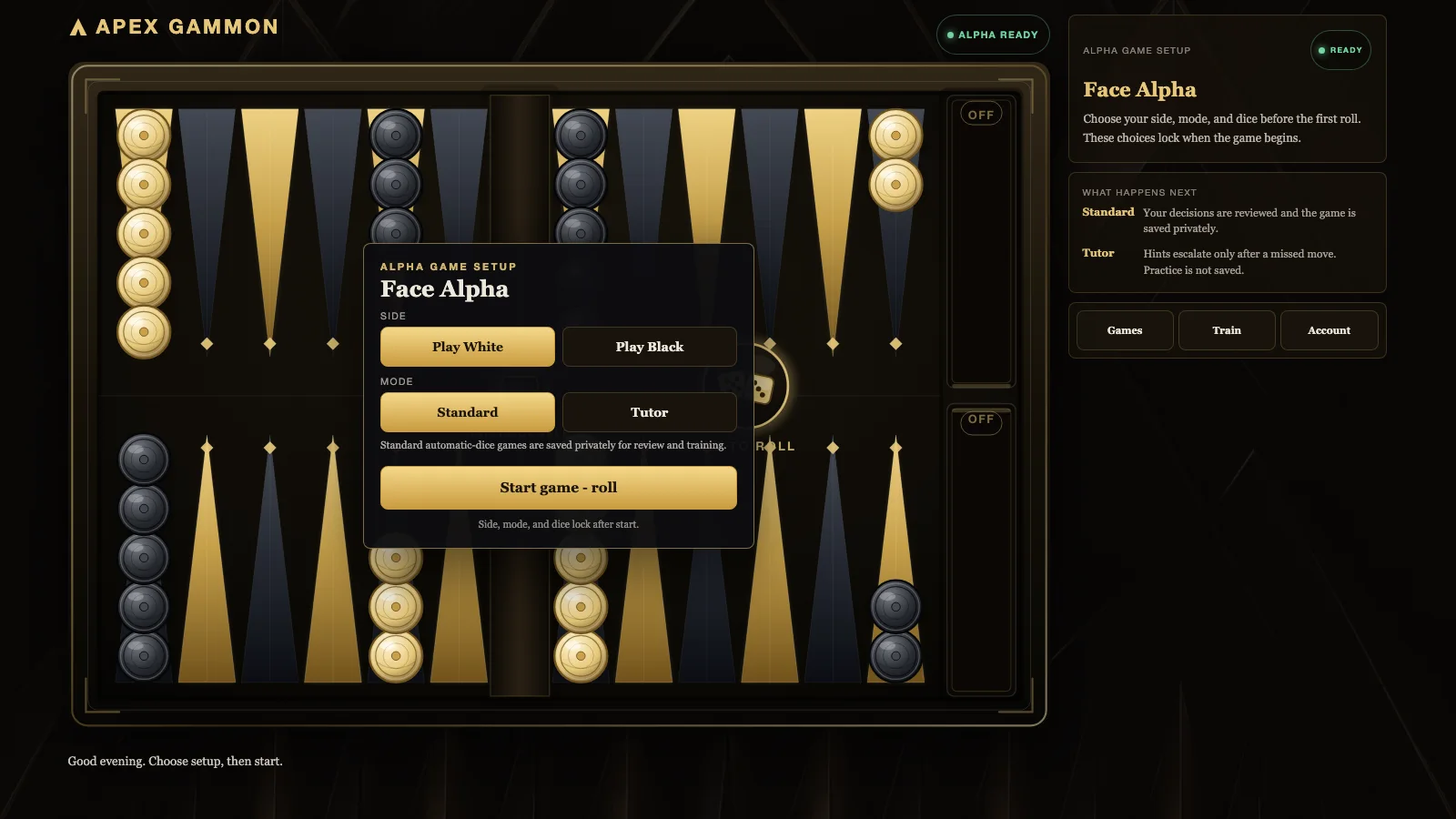
Board setup
The twenty-four narrow triangles are called points. Each player moves in the opposite direction, from their 24-point toward their 1-point and then off the board. In the standard setup, each player has two checkers on the 24-point, five on the 13-point, three on the 8-point, and five on the 6-point, viewed from that player's perspective.
A point with two or more opposing checkers is closed. You may not land there. A point with exactly one opposing checker is a blot and can be hit.
Rolling and moving
Roll two dice. Each die is a separate move: a 5-3 can move one checker five points and another checker three points, or the same checker five and then three when both intermediate landings are legal. The order can matter because each landing must be legal at the moment it occurs.
- If both dice can be played, both must be played.
- If only one die can be played, that die must be used.
- If either die can be played but not both, the higher die must be played.
- Doubles are played four times, so 4-4 provides four separate moves of four points.
Hitting and entering from the bar
Landing on an opposing blot sends that checker to the bar. A player with any checker on the bar must enter it before moving another checker. Entry uses the opponent's home board: a roll of 1 enters on the 24-point, a 2 on the 23-point, and so on from the entering player's perspective. A closed entry point cannot be used.
If neither die can enter, the turn is lost. If one checker can enter and a second die remains legal, play continues with that die.
Bearing off
You may bear off only when all fifteen checkers are in your home board and none is on the bar. An exact die removes a checker from the matching point. A higher die may remove a checker from the highest occupied lower point only when there is no checker on a higher point.
For example, with no checker on the 6-point, a six may bear off a checker from the 5-point. If a checker remains on the 6-point, the six must be used there.
Winning, gammons, and backgammons
A normal win is one point. A gammon is worth two points when the loser has borne off no checkers. A backgammon is worth three points when the loser has borne off none and still has a checker on the bar or in the winner's home board. The current doubling-cube value multiplies that result.
The doubling cube
Before rolling, a player who owns access to the cube may offer to double the game's value. The opponent can take and continue at the new value or pass and lose the current value. After a take, cube ownership moves to the taker, who alone can offer the next redouble. Match play can add the Crawford rule and score-dependent cube strategy.
You roll 6-4, but only one die can be played. Both the six and four are individually legal. Which must you use?
Put the refresher into motion.
The free Cosmo board enforces legal movement, bar priority, doubles, bearing off, and the cube.