Performance rating explained.
Performance rating, or PR, summarizes how much normalized equity a player gave up per decision. Lower PR is better. It measures decision quality against the analysis reference, not whether the dice produced a win.
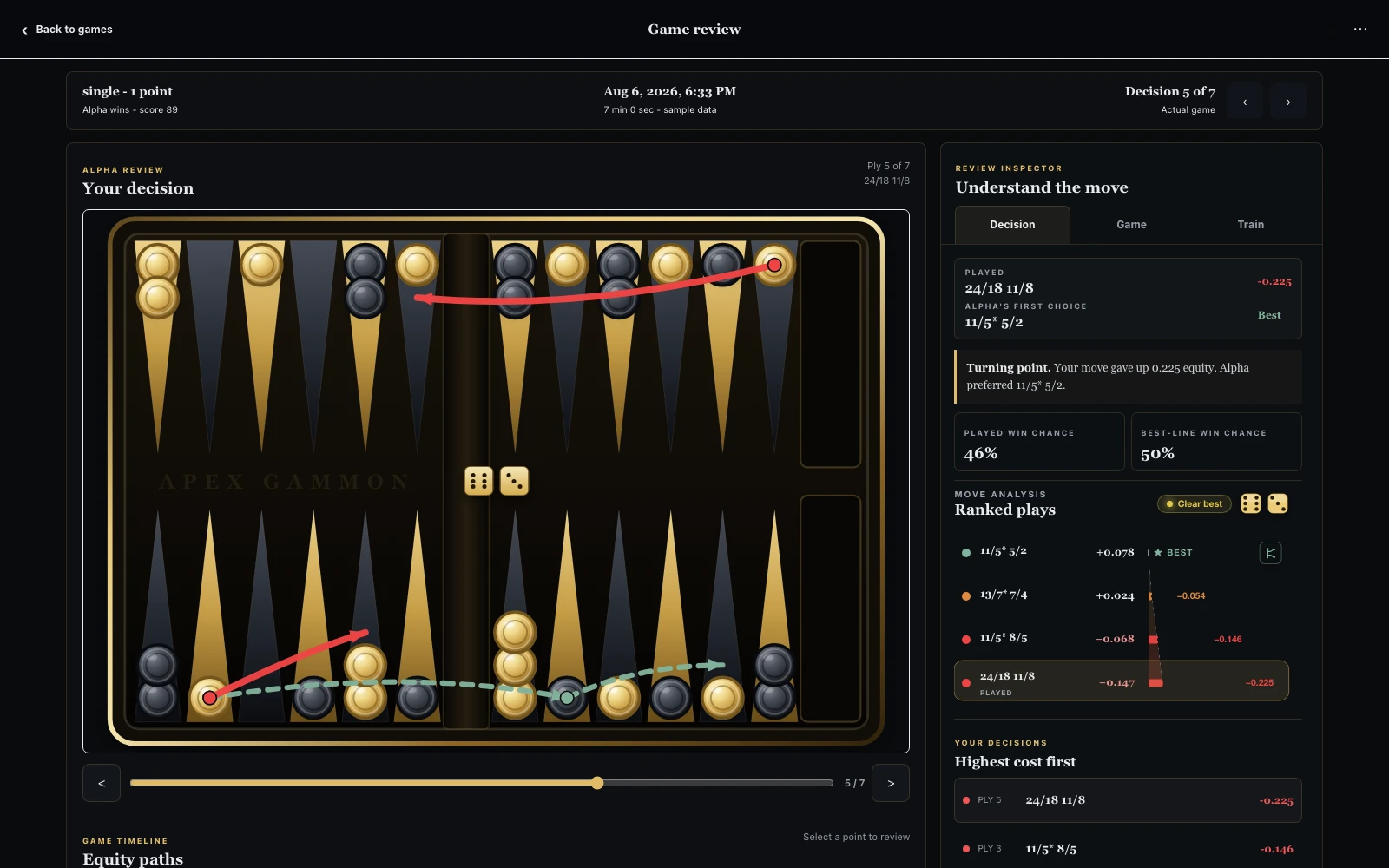
Start with equity loss
For each decision, analysis compares the played action with its top-ranked action. If the best move is valued at +0.240 and the played move at +0.190, the decision loss is 0.050 in that evaluation scale. Correct or effectively tied choices contribute little or no loss; large checker or cube errors contribute more.
Because equity scales can differ between money play and match play, analysis systems may normalize error before calculating PR. Compare ratings from the same methodology when possible.
From loss to PR
A common presentation scales average normalized error per decision into a readable PR. Apex displays the calculation beside the result and uses the corresponding product score:
PR = normalized total decision loss / counted decisions x 500
Apex performance score = 100 - PR, bounded from 0 to 100.
The score is intentionally intuitive: 100 represents no measured decision loss, and larger errors reduce the score rather than increase it.
What should be counted
Meaningful checker decisions and cube decisions belong in performance analysis. Forced moves contribute no choice and should not make a rating appear better merely by increasing the denominator. Tutor games are practice sessions rather than independent tests, so Apex excludes them from saved Standard-game review and performance history.
One game is noisy
A short game can contain very few decisions. One difficult choice may dominate the rating, while a long forced race may reveal little. Use a single-game PR to find positions to study, not to define a player's level. Trends across many decisions are more informative.
- Review the largest errors first.
- Separate checker-play and cube themes.
- Track repeated mistake types, not only the average.
- Use training recall to verify that the lesson sticks.
PR and luck answer different questions
Luck describes how rolls changed outcome equity relative to expectation. PR describes the quality of choices. A player can make excellent decisions and lose, or play poorly and win. Apex keeps optional luck calculation in post-game review so live play remains focused and the two ideas are not conflated.
You lose a game but record very little decision error. What does the low PR indicate?
Turn the summary back into decisions.
Use the transparent calculator, then inspect how ranked alternatives create the total.